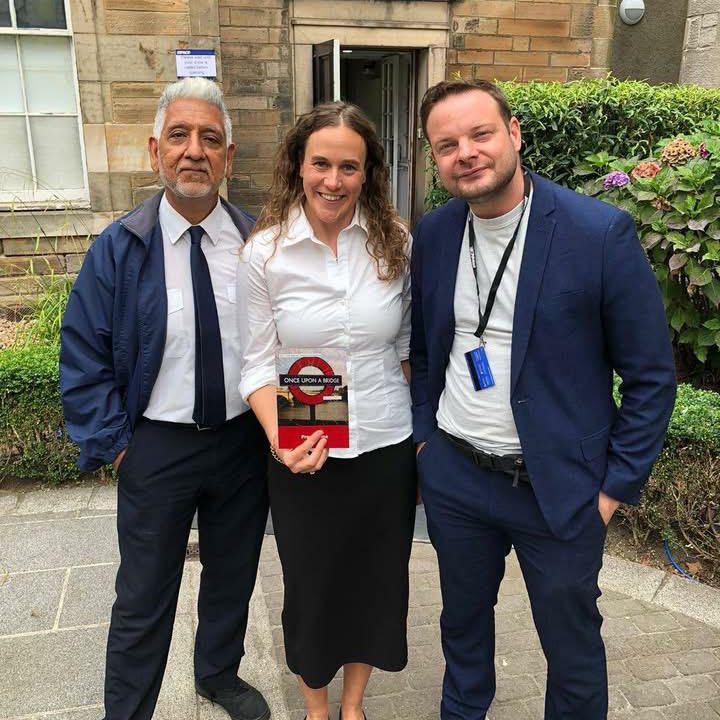
While our Once Upon A Bridge team are up in Scotland performing at the Edinburgh Fringe Festival, here are some of the comments given by those audience members who have taken the time to see their show!
Great show! Solid acting. Emotional and truthful. Highly recommeded.
- Molly
We have seen over 50 theatre productions in the last 15 days and this must be one of the top 5
- Carolyn Emery
Brilliant acting in this fast paced play that leaves unanswered questions. Beautiful poetic writing well worth seeing.
- Susanne
Outstanding flawless performances from the cast. I was engrossed in the stories from start to finish. One of my 3 top pieces I've seen this Fringe.
- Lindsay Seal
This is a compelling, emotional and thoroughly enjoyable show with excellent performances and a compelling narrative. Highly recommend! Not to be missed!
- Tim
An intricate and engaging retelling of a horrific real event. Beautifully acted and great light and shade! Highly recommend! Don't miss it this Fringe!
- @servicepleasefringe
What a fantastic interpretation of a real life event! The simplistic interrogation style staging really informed the performance and allowed the actors to deliver the fantastic and well developed tone of each character, creating a superb engaging performance. Well written and well acted. Don't miss this show at the Fringe!
- Connie Peel
Once Upon a Bridge is a taut, finely crafted piece of theatre that takes as its starting point a shocking real-life incident and turns it into a study of chance, choice, and consequence. Based on the notorious moment in 2017 when a woman was pushed by a jogger into the path of a bus on Putney Bridge, Sonya Kelly’s play imagines what brought three strangers – the jogger, the bus driver, and the woman – to that very point in time.
The staging is stripped back to three chairs, but the simplicity only heightens the intensity. With no distractions, every gesture and every word counts. The dramatic tension is palpable throughout, as the narrative shifts between perspectives, gradually weaving together a picture of ordinary lives colliding in extraordinary, and near-tragic, fashion.
Claire Louise Moss is compelling as the young woman, nervous but hopeful as she heads to an interview at a law firm. Gurmej Vik brings depth and humanity to the bus driver, a family man constantly looking over his shoulder, terrified of losing his job under the management’s relentless obsession with timekeeping and surveillance. Luke Willis captures the tightly wound energy of the jogger – driven, restless, and brittle under the weight of his own ambitions.
Despite the occasional audible sound from surrounding theatres and the courtyard, the three actors hold the audience completely. For the duration of the play, they keep us in the palm of their hands, building tension until the final moment. A short but riveting piece, Once Upon a Bridge is a reminder of how a single instant can alter lives forever and is unmissable.
- Rona, One4Review
Translating real events into a drama for the stage is a challenging quest, but the Lace Market Theatre have succeeded with a clear and compelling presentation in Once Upon a Bridge at theSpace at Surgeons Hall.
A reminder of how easy it is to become part of life-changing events in the impersonal urban jungle
On 5 May 2017, a jogger inexplicably shoved a woman into the path of a London bus on Putney Bridge, leaving the driver to narrowly avoid tragedy. Caught on CCTV, the assailant ran on as though nothing had happened. Dubbed the “Putney Pusher”, he was never identified, despite a police appeal and widespread media coverage.
Sonya Kelly’s play reimagines this random act of violence in a powerfully chilling and intriguing “what if?”. Director Beverley Anthony seats the three characters most intimately involved in the incident on evenly spaced chairs, face-on to the audience, resembling interviewees. It is a starkly simple device that appropriately reflects the gravity of the situation. In turn, they provide backgrounds to themselves, relate their side of the story and reflect on how it has affected them.
Luke Willis creates a cocky, self-assured jogger who almost manages to remain oblivious to the possible consequences of his actions until the horrors finally overwhelm him and he breaks down emotionally. Clare Moss sensitively and delicately relates the traumatic experience the woman endured, wondering why it had to happen to her. Gurmej Virk similarly describes events as the dutiful bus driver – a family man who takes pride in his work and punctuality and always seeks to do his very best.
There is great imagination in the creation of the characters and their lives, which draws interest in them as people. Their narratives eventually collide, and the first exchange of words towards the end comes as a dramatic breakthrough.
It is a reminder of how easy it is to become part of life-changing events in the impersonal urban jungle.
- Richard Beck from broadwaybaby.com
Back in 2017, the ‘Putney Pusher’ was the name given to the assault, and arguably attempted manslaughter, of a woman on Putney Bridge, in London. As the un-named woman was walking across the bridge, a male jogger shoved her into the road, directly into the path of an approaching London bus. It was only the swift actions of the bus driver that prevented a tragedy. Police investigated, arresting three men, but ultimately, no charges have ever been brought.
Sonya Kelly’s play, brought to the Edinburgh Fringe by Nottingham based Lace Market Theatre, takes this incident as its origin point, and weaves a tale of who the people involved may have been, and what the impact on them might have been.
There are only three characters in the play: Woman; Bus Driver; and Man. The performance is staged with each character positioned on a chair, lit in their own pool of light. Our focus is directed from one character to another by who is lit at any time. Part-way through, as the action converges on that moment on the bridge, everyone speaks over each other, making the only time we see all the characters illuminated. It’s a very clever way to tell the story with no other props or set. We’re forced to focus on the story being told, to listen to what these characters are saying.
For all that they don’t have names, we learn a lot about each of our characters.
Woman (Clare Louise Moss) is Irish. Her granny lived in London, decades ago, but only briefly. She was pushed down the stairs by a man at Piccadilly Circus tube station, who displayed both classism and sexism, and treated her as if she was a nuisance. That granny was noticeably heavily pregnant made things worse. She lost a job because of the incident, and fled back to Ireland, never to return.
Woman is here, now, in contemporary London, to be a barrister - seeking justice for those, like her granny, who are overlooked, ignored, treated as inconvenient. Moss’ role calls for her to code switch between a relatively strong Irish accent, and the plummy tones of the Oxbridge educated elite - members of the same class of privileged English person who feels entitled to power and influence. Moss’ acting here is exemplary, capturing the spirit of triumph and happiness of Woman, contrasted with the snobbishness of those around her.
Man is a finance-bro. He speaks with a broad accent that’s either Essex or approaching Cockney, but either way he’s entirely coded as a ‘geezer’, a ‘chancer’, a ‘bit of a lad’. He put my back up immediately, which is testament to Luke Willis’ excellent acting.
He’s disingenuous almost from the moment we meet him - pretending to be something he isn’t to impress an American lawyer at a friend’s wedding, and continuing to lie to her throughout their relationship. It’s very clear that, however much he pretends, he’s very far from being the gentleman he aspires to be.
In fact, Man is a ball of barely suppressed rage, with a sense of entitlement that sees him lashing out at a female colleague at work. He also deeply buys into the culture of conspicuous consumption, yearning for a house in Hampstead that he can’t yet afford.
Bus Driver (Gurmej Virk) is immediately very sympathetic. He’s just a guy, doing his job, and trying to do the best for his family. He’s an immigrant, and he works a terrible shift pattern for one of London’s bus companies, with a supervisor who appears to be all stick, and no carrot. But Bus Driver loves his job. He takes pride in it. He recalls passing the final test to become qualified, and recalls being told that he has a duty to look after his passengers and other road users. It’s a responsibility he takes seriously.
We watch as the events of that terrible day draw nearer. From years, decades in the past even, we move closer and closer, when the format changes, from one person speaking, to everyone talking over each other. It’s a clever way to convey the chaos and adrenalin of the moments immediately after Woman has been shoved into the road.
There’s a lot here about different notions of masculinity. Bus Driver is gentle, careful, considerate, and hard-working. Man thinks that the world owes him, and that anything anyone else has, reduces his opportunities. Bus Driver can see that the pie expands to have enough for everyone: Man thinks that all of the pie should be his. It’s stretching a metaphor, but at times, this play is similarly indulgent.
But only occasionally. Woman has the most whimsy, with her memories of Granny back in Ireland, but it’s off-set with the occasional political barb, moments which increase in the aftermath of the incident, as Woman finds her voice, and expresses her rage.
This is an exceptionally well put together production of an intriguing play, that will make you reflect on how the tiniest of moments can have the deepest repercussions.
- Anne-Louise Fortune from fromthenorthculture.co.uk
And here's a vlog from Luke on day 4 at The Fringe...
https://youtube.com/shorts/1r4p7bfwO3A?si=p5A56TEj8yQ7jyVV
